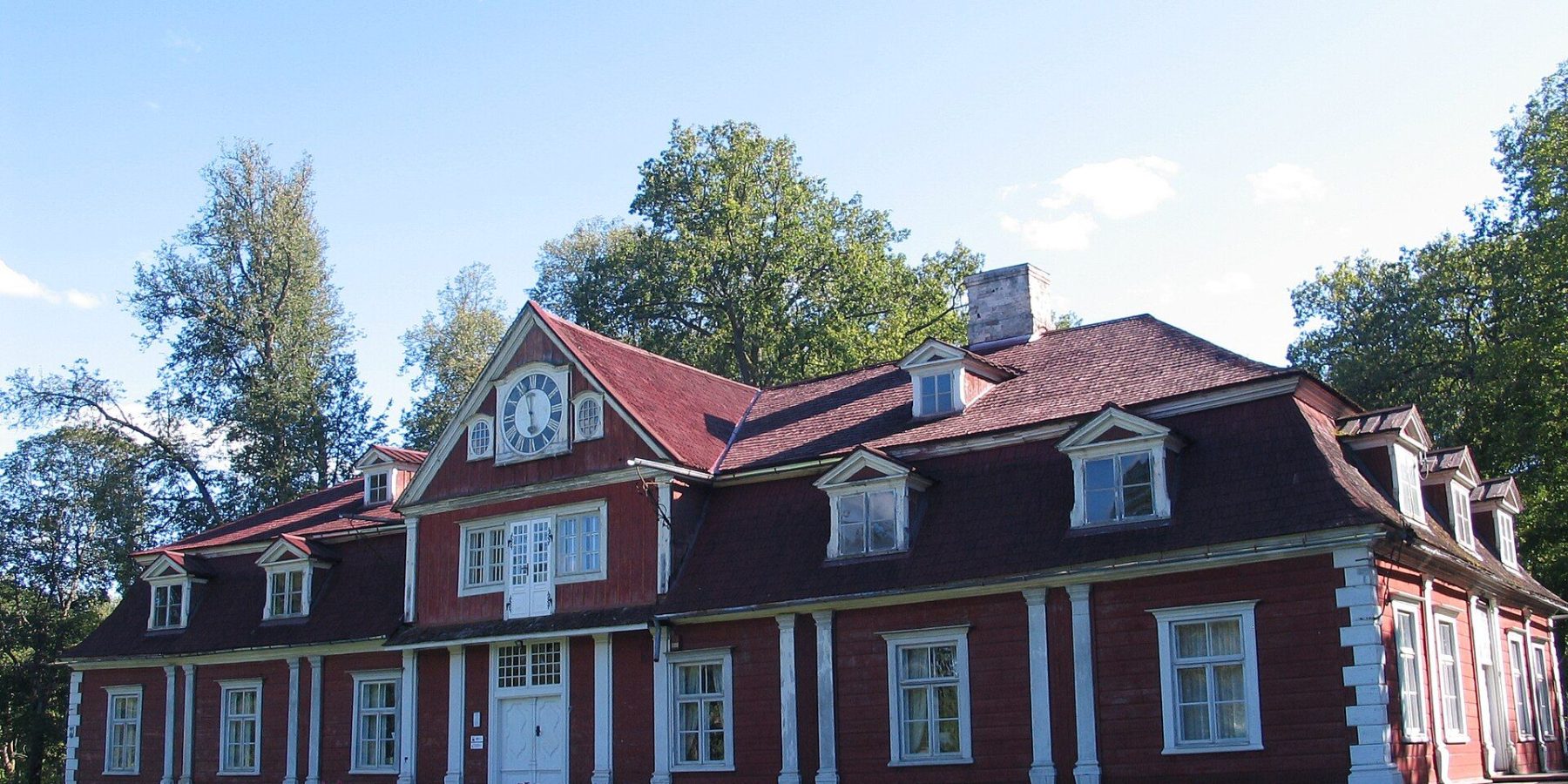
Ungurmuiža, in Gauja National Park between Cēsis and Straupe, is a rare 18th-century wooden ensemble: a Baroque manor house, a chapel and a tea house set in a linden park. The Cēsis tourist office calls it the only surviving Baroque wooden manor in Latvia, and its greatest treasure is the 18th-century wall paintings that cover the rooms from floor to attic.
At a glance
| Manor house built | 1731–1732, Baroque, wooden |
| Owners | The von Campenhausen family (1728–1939) |
| Wall paintings | Georg Dietrich Hinsch, 1750–1762 |
| Address | Ungurmuiža, Raiskums parish, Cēsis Municipality |
| Distance | About 15 km from Cēsis, about 80 km from Riga |
| Status | Cultural monument of national importance in Gauja National Park |
Home of the Campenhausens
The estate takes its name from the von Ungern family, who owned it until the mid-17th century; in German it was called Orellen. After the Great Northern War, in 1728, Johann Balthasar von Campenhausen bought it, and his family stayed for more than two centuries, until 1939. The new manor house was built in 1731–1732 and was one of the first grand buildings put up in Vidzeme after the war. Its mansard roof and mezzanine set a pattern for manor building for decades.
Unlike most manors, Ungurmuiža was not nationalised in the land reform of the 1920s. The family history has dark pages too: Balthasar Armin von Campenhausen was shot by the Bolsheviks in Cēsis on 26 May 1919.
Wall paintings, chapel and tea house
Between 1750 and 1762 the interiors were painted by Georg Dietrich Hinsch, an artist from Limbaži. They are among the richest Baroque wall and ceiling paintings in Vidzeme. Some were painted over during a 1959–1961 remodelling, but in the 1970s, after Gauja National Park was founded in 1974, restorer Dace Puķīte uncovered and restored them.
The ensemble also includes the family chapel, built in 1760, and a tea house at the far end of the park, built in 1753 and restored in 1977. Around the buildings lies a linden park laid out in 1733, with clipped linden alleys and old oaks. Many buildings keep their original timber beams and details, so the whole place shows clearly what an 18th-century Vidzeme manor looked like.
Ungurmuiža today
Ungurmuiža belongs to Cēsis Municipality. For years it housed a history exhibition and a restaurant, but its operators have changed recently: the previous tenant pulled out in October 2025, and in April 2026 the municipality held a new auction for the lease, aiming to preserve the ensemble and keep it open to the public. Visiting arrangements may therefore change — the park and the exterior can be seen at any time, but interior visits must be booked in advance.
Did you know?
Despite how it sounds in Latvian, Ungurmuiža has nothing to do with Hungary — the name comes from the Baltic German von Ungern family, who owned the estate before the Campenhausens.
Visiting
- Getting there: Ungurmuiža is in Raiskums parish, about 15 km from Cēsis; a car is the easiest option, and there is free parking.
- Interiors: by appointment. The phone number given on ungurmuiza.lv is +371 22007332; at last report the restaurant was temporarily closed. Check current information before you go.
- Time needed: an hour for the park and exteriors; 1.5–2 hours with an interior tour.
- Combine with: Cēsis Medieval Castle, Turaida Castle and the Līgatne Nature Trails.
FAQ
What makes Ungurmuiža special?
It is a Baroque wooden manor house built in 1731–1732 with 18th-century wall paintings; the Cēsis tourist office calls it the only surviving manor of its kind in Latvia.
Can you go inside Ungurmuiža?
Yes, but interior visits must be booked ahead, and arrangements may change while the operator changes. The park and exteriors are freely accessible.
Who owned Ungurmuiža?
The von Campenhausen family from 1728 to 1939; today it belongs to Cēsis Municipality.
Sources: lv.wikipedia.org “Ungurmuiža”; en.wikipedia.org “Ungurmuiža Manor”; visit.cesis.lv (Ungurmuiža); ungurmuiza.lv; LV portāls (2024, 2026) on the lease auctions. Visiting arrangements change — check before you go.