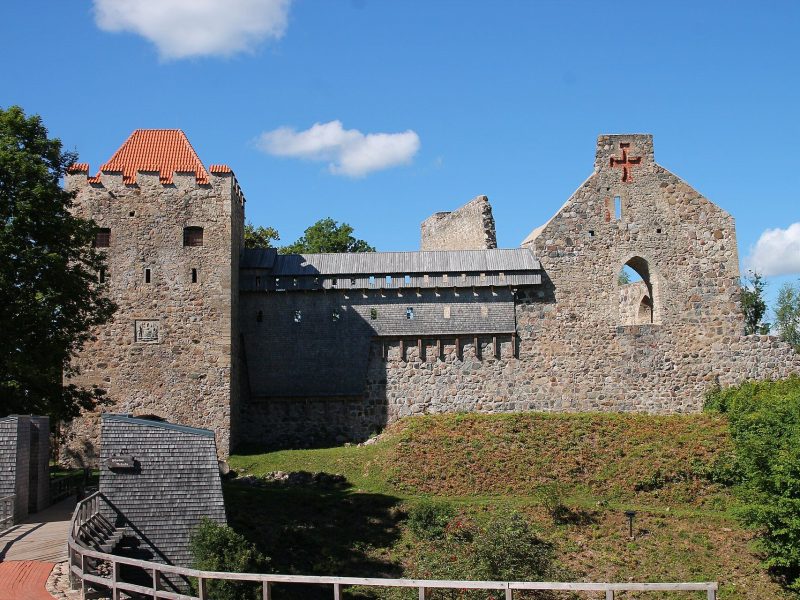
With its round red-brick main tower rising above the Gauja valley, Turaida Castle is one of the most recognisable views in Latvia. It stands on the right bank of the Gauja, across the river from Sigulda, at the centre of the Turaida Museum Reserve — an area where a medieval castle, an 18th-century wooden church, the grave of the Rose of Turaida and the Folk Song Hill sit within walking distance of each other.
At a glance
| Location | Turaidas iela 10, Sigulda — right bank of the Gauja, Gauja National Park |
| Built | Stone castle begun in 1214, under Bishop Albert of Riga |
| Original name | Fredeland (German for “land of peace”) |
| Style | Medieval castle, mostly of red brick |
| What to see | Main tower with valley views, exhibitions in the castle buildings, church, grave of the Rose of Turaida, Folk Song Hill |
| Museum Reserve | Founded 1988; 43.63 ha with 37 buildings and structures |
| Time needed | 2–3 hours for the whole reserve |
History of the castle
From a Liv hillfort to a bishop’s stronghold
Before the stone castle, a wooden Liv fortress stood here, associated with the Liv leader Kaupo. After the land was divided in 1207, the right bank of the Gauja went to Bishop Albert of Riga, and in 1214 work began on a stone castle. It was named Fredeland, “land of peace”, but the local name Turaida soon took over.
The castle served as the administrative seat of the bishop’s (later archbishop’s) estates and changed hands with the Livonian Order several times. Over the centuries the compact fortress grew: a tower-like southern block was added in the 14th century and a semi-circular western tower in the early 15th. The castle reached its largest extent in the early 16th century.
Fire, ruin and restoration
After a fire in 1776 the castle was abandoned and slowly fell into ruin. In the 19th century a manor house was built next to the main tower and the west wing was used as a granary. Restoration began in the 1950s, and in 1976 regular archaeological excavations started under Jānis Graudonis, continuing for 25 years. The rebuilding drew on the excavation results and on drawings from 1793 and 1810 found in Estonian archives.
What to see in the reserve
- The main tower — the highest point of the castle, with views over the Gauja valley towards Sigulda.
- Castle buildings — the southern block and other restored buildings hold exhibitions on the history of the castle and the area.
- Turaida Church — built in 1750 on Church Hill, one of the oldest surviving wooden churches in Latvia.
- Grave of the Rose of Turaida — under a linden tree by the church; newlyweds traditionally leave flowers here.
- Folk Song Hill (Dainu kalns) — a sculpture park dedicated to Latvian folk songs and their collector Krišjānis Barons.
The legend of the Rose of Turaida
The story follows Maija, found as a baby after a battle at the castle in 1601 and raised by the castle clerk. In 1620 she was to marry Viktors, the gardener of Sigulda Castle. Before the wedding a Polish soldier lured her to Gūtmanis Cave with a forged letter. To escape, she claimed her scarf protected the wearer from wounds and told him to test it on her — and he killed her. Viktors buried her by the church and planted a linden on the grave.
The tale is based on court records retold by Magnus von Wolffeldt in 1848, and became widely known through Rainis’s play “Love Is Stronger than Death” (1927).
Did you know?
In 2018 the Turaida Museum Reserve welcomed more than 273,000 visitors, making it the most visited museum in Latvia that year.
Visiting
- Getting there: Riga to Sigulda by train or car (about 50 km), then a local bus, taxi or car across the Gauja to Turaida. There is a paid car park at the reserve.
- Opening hours: May–September 9:00–20:00, October 9:00–19:00, November–April 10:00–17:00; indoor exhibitions 10:00–18:00. Hours and prices change — check tmr.gov.lv before you go.
- Tickets: adults €9, seniors €7, students €6, pupils €3; family ticket (2 adults + children) €19.
- Time needed: 2–3 hours; half a day with a walk along the Gauja.
- Combine with: Gūtmanis Cave on the way and the sights of Sigulda; further up the Gauja, the Līgatne nature trails and Cēsis Medieval Castle.
Frequently asked questions
Is Turaida Castle in Sigulda?
Administratively yes — the address is Turaidas iela 10, Sigulda. The castle stands on the right bank of the Gauja, across the river from Sigulda town centre.
Can you climb the tower?
Yes, the main tower is open to visitors and looks out over the Gauja valley. Entry is included in the museum reserve ticket.
Where is the Rose of Turaida buried?
On Church Hill next to the wooden Turaida Church, inside the reserve and a few minutes’ walk from the castle.
Sources: Turaida Museum Reserve official site tmr.gov.lv (hours, prices, address); lv.wikipedia.org “Turaidas pils” and “Turaidas muzejrezervāts”; en.wikipedia.org “Turaida Castle” and “Rose of Turaida”.