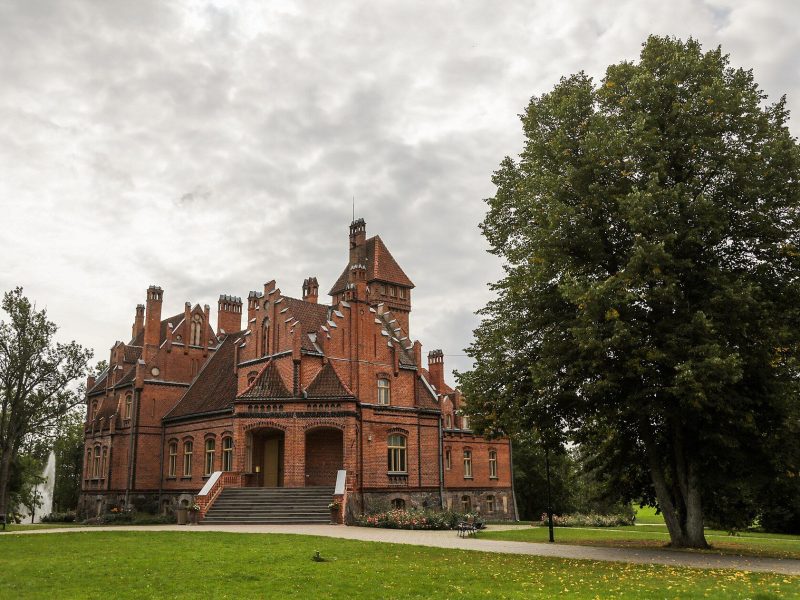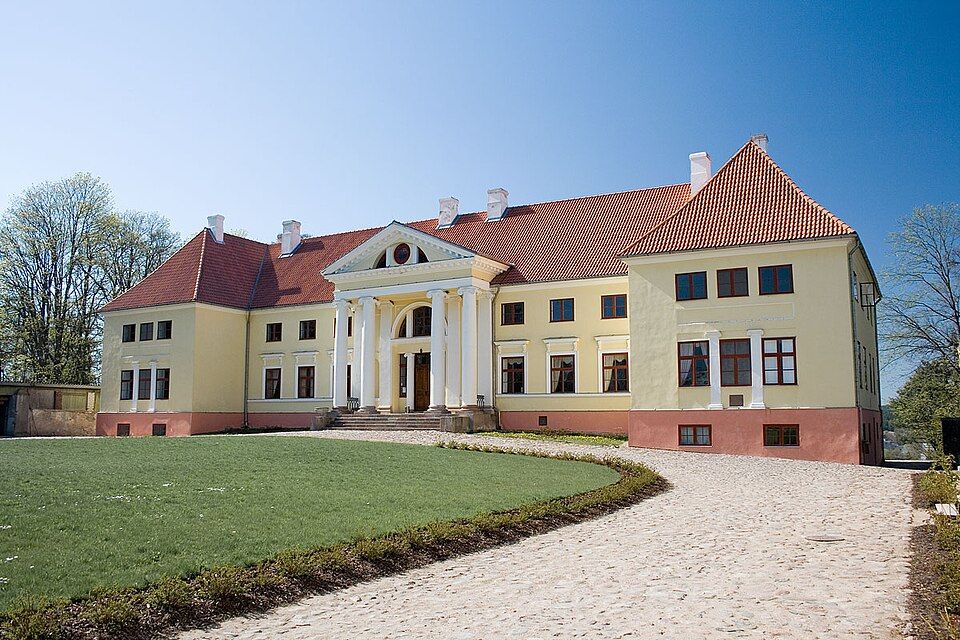
Durbe Manor is a Neoclassical manor house right in the town of Tukums, on the edge of the Slocene river valley. Don’t confuse it with the medieval Durbe castle ruins in southern Kurzeme — this is the Tukums manor where the poet Rainis was the owner in the 1920s, and today it is a branch of Tukums Museum with late-19th-century interiors, exhibitions and a romantic landscape park.
At a glance
| Address | Mazā Parka iela 7, Tukums |
| First recorded | 1644, as the Schlockenbeck semi-manor |
| Present look | Neoclassical; façades remodelled in 1821 to a design by J. G. A. Berlitz |
| Notable owners | the Grotthuss family, Count Medem, the barons von der Recke, the poet Rainis |
| Today | Branch of Tukums Museum |
| Park | English landscape park with a rotunda, bridges and a fountain |
From semi-manor to Neoclassical palace
The site was first recorded in 1644 as the Schlockenbeck semi-manor, with a residence mentioned in 1671. Between 1754 and 1786 Otto Philipp von Grotthuss, chief master of the hunt to the Duke of Courland, built a new manor house and a walled service courtyard with a servants’ house, stables, carriage shed, barn and granary. Ernst von Grotthuss later added two side wings and a second floor.
The house got its present look under Count Medem, who owned the estate from 1818 to 1838: in 1821 the façades were remodelled in Neoclassical style and a portico added to a design by architect Johann Georg Adam Berlitz. In 1848 the barons von der Recke bought the estate and kept it until the land reform of 1920.
Rainis’s manor and later years
In 1923 the government gave the manor to the poet Rainis. He stayed only for short periods and turned it into a holiday home for teachers; after his death in 1929 a Rainis museum was set up here. The building later served as a sanatorium, a wartime hospital in 1943, a tuberculosis hospital from 1963 and a rehabilitation hospital. After independence was restored, the manor and neighbouring buildings were handed to Tukums Museum.
What to see
The ground floor has reconstructed interiors from the late 19th and early 20th centuries; the first floor hosts research-based history and art exhibitions, including one on Rainis and his ties to Durbe. Concerts and events are held here too. The English-style landscape park, laid out to Berlitz’s plan, has a rotunda, two stone bridges, gazebos and a fountain in the valley by the river, and is being gradually restored.
Did you know?
Rainis received Durbe Manor as a gift from the state in 1923 but rarely stayed there himself — he mainly used it as a holiday home for teachers and their families.
Visiting
- Getting there: Mazā Parka iela 7, Tukums — take the train from Riga to Tukums and walk through town.
- Hours and price: the manor is a branch of Tukums Museum and entry is with a museum ticket; usually closed on Mondays. The park is open in daylight. Check current hours and prices at tukumamuzejs.lv or call +371 26305946.
- Time needed: 1–1.5 hours for the house and park.
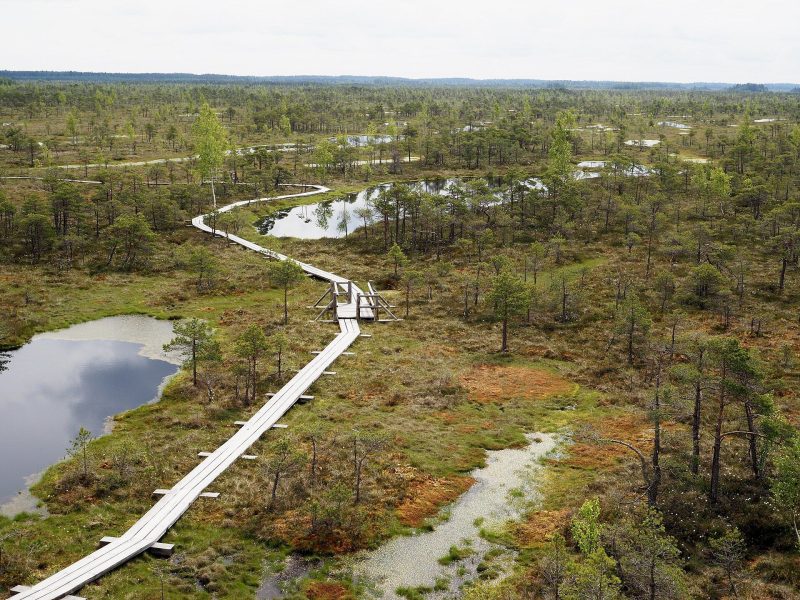
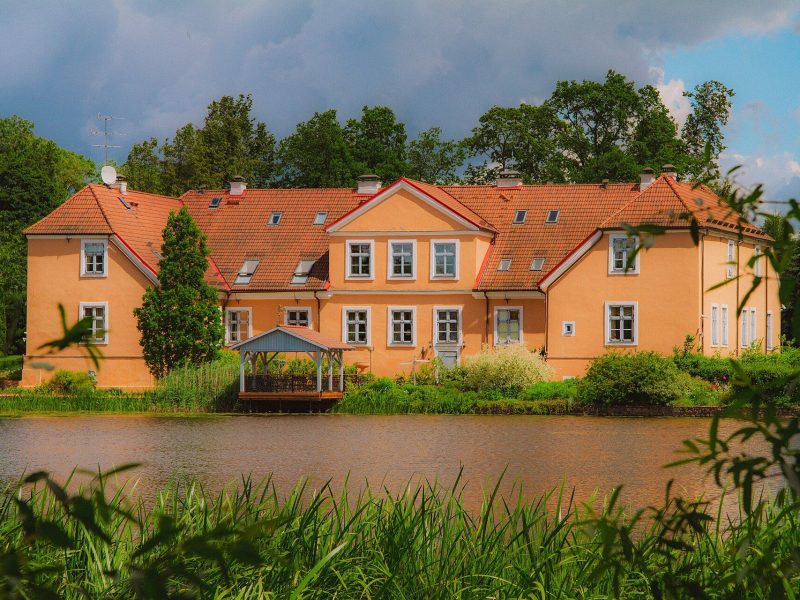
- Combine with: Jaunmoki Palace near Tukums, Jaunpils Castle or the Ķemeri bog boardwalk.
FAQ
Is this the same as the Durbe castle ruins?
No. Durbe Manor is in Tukums; the medieval Durbe castle ruins are in the town of Durbe in southern Kurzeme.
What is the link with Rainis?
The government gave the manor to Rainis in 1923 and he used it as a holiday home for teachers. A Rainis museum was set up after his death, and the first floor still has an exhibition about him.
Is the park free?
Yes, the park is open in daylight hours; you only pay to enter the museum in the house.
Sources: lv.wikipedia.org “Durbes muiža”; en.wikipedia.org “Durbe Manor”; visittukums.lv; muzeji.lv; tukumamuzejs.lv. Opening hours change — check before you go.