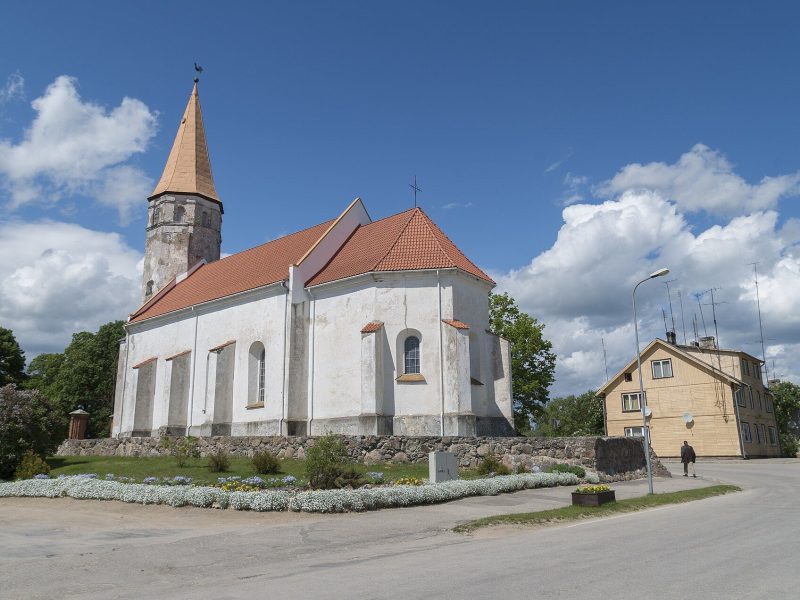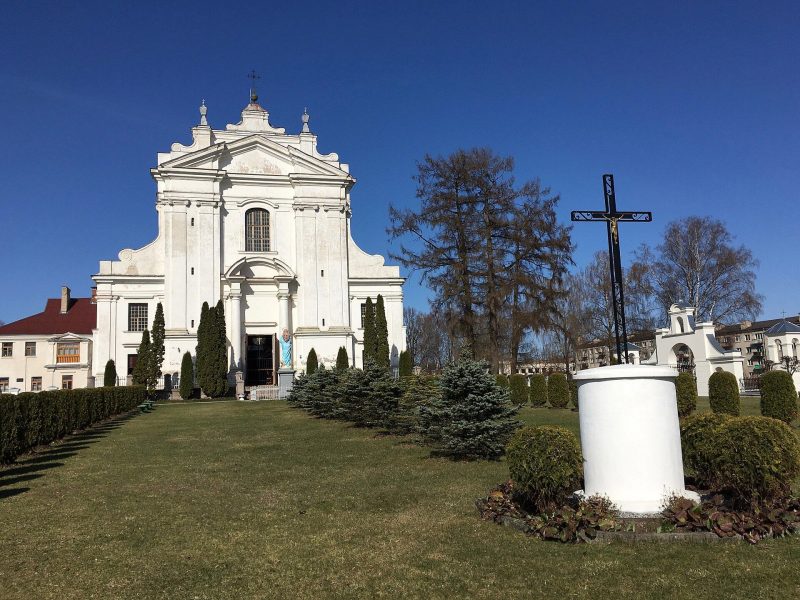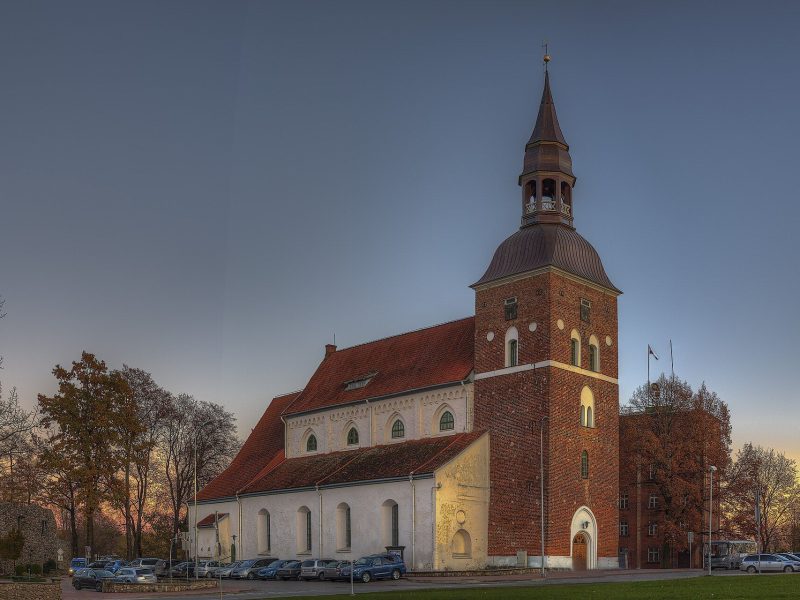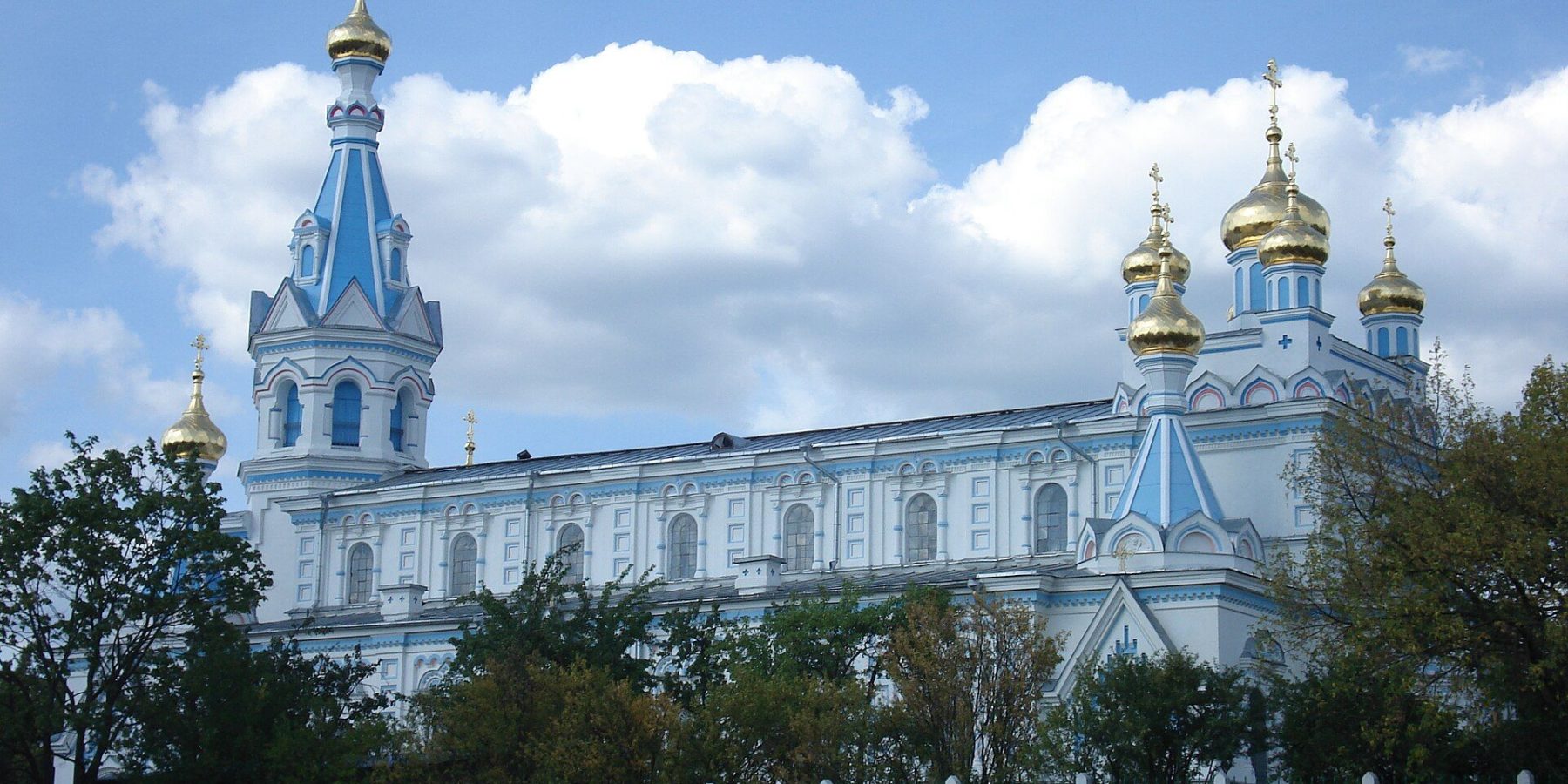
On a low rise in Daugavpils’s Jaunbūve district, churches of four confessions stand side by side — Orthodox, Catholic, Lutheran and Old Believer. Locals call it Church Hill (Baznīckalns), and its largest and most richly decorated building is the white-and-blue Orthodox Cathedral of the Holy Martyrs Boris and Gleb, with its ten towers.
At a glance
| Confession | Orthodox (Latvian Orthodox Church) |
| Built | 1904–1905 |
| Architect | Unknown; funded by the army’s clergy department |
| Style | Russian historicism of c. 1900 (Neo-Russian style) |
| Highlights | 10 towers with cupolas; oak iconostasis with three Royal Doors |
| Setting | Church Hill, with churches of four confessions side by side |
From the “iron church” to a cathedral
Before the present cathedral, a so-called iron church was built here in 1866 for the garrison. In 1904 the Polotsk eparchy had it moved to Jersika, and in 1904–1905 the new brick church went up in its place. The architect is unknown — the work was funded by the military department in charge of the army’s religious affairs. It was consecrated in 1905 in honour of the holy princes Boris and Gleb and St Alexius, Metropolitan of Moscow.
A permanent parish was formed in 1922, and from 1925 two congregations, Latvian and Russian, worshipped here. In 1938 Bishop Alexander of Jersika was consecrated in the church, which became his seat — hence the title of cathedral.
Architecture and iconostasis
The church is a long rectangle with a raised central nave and two side aisles, and its silhouette is sometimes likened to a ship. Towers rise at the ends of the aisles, five small turrets crown the east end of the central section, and a belfry over the entrance originally held four bells. In the first half of the 20th century all ten cupolas were gilded. The façades have wedge-shaped arches, columns and pediments, an image of Christ above the entrance and a mural of Boris and Gleb on the south wall.
Inside, walls and ceilings are covered with paintings. The iconostasis has a polished oak frame with partly gilded carving and, unusually, three Royal Doors instead of one. Its icons are thought by some to be copies of Viktor Vasnetsov’s work in St Volodymyr’s Cathedral in Kyiv. The iconostasis and 19 icons are protected as works of art of national importance.
Did you know?
The original “iron church” that once stood on this spot was never demolished — it was moved to Jersika, where it still stands.
Visiting
- Where: Tautas iela 2, Daugavpils, in the Jaunbūve district on Church Hill, a short ride from the centre.
- When: the cathedral is open for services; no official visitor hours are published. Tel. +371 65453544.
- Etiquette: in Orthodox churches women usually cover their heads and wear skirts, men remove hats, and worshippers stand during services. Ask before taking photos.
- Combine with: the other churches on Church Hill — the Catholic Church of the Immaculate Conception, Martin Luther Cathedral and the Old Believers’ prayer house. Aglona Basilica is about an hour’s drive away.
- Info: Daugavpils Tourist Information Centre, Rīgas iela 22a, +371 65422818.
FAQ
What is Church Hill in Daugavpils?
A rise in the Jaunbūve district where churches of four confessions stand together: the Orthodox Boris and Gleb Cathedral, a Catholic church, Martin Luther Cathedral and an Old Believers’ prayer house.
Who designed the cathedral?
The architect is unknown. Construction in 1904–1905 was funded by the army’s clergy department.
Can tourists go inside?
Yes, as long as you follow Orthodox etiquette. Visit around service times and keep quiet.
Sources: visitdaugavpils.lv; en.wikipedia.org “Ss. Boris and Gleb Cathedral, Daugavpils”. Opening times can change — contact the parish or tourist office before you go.