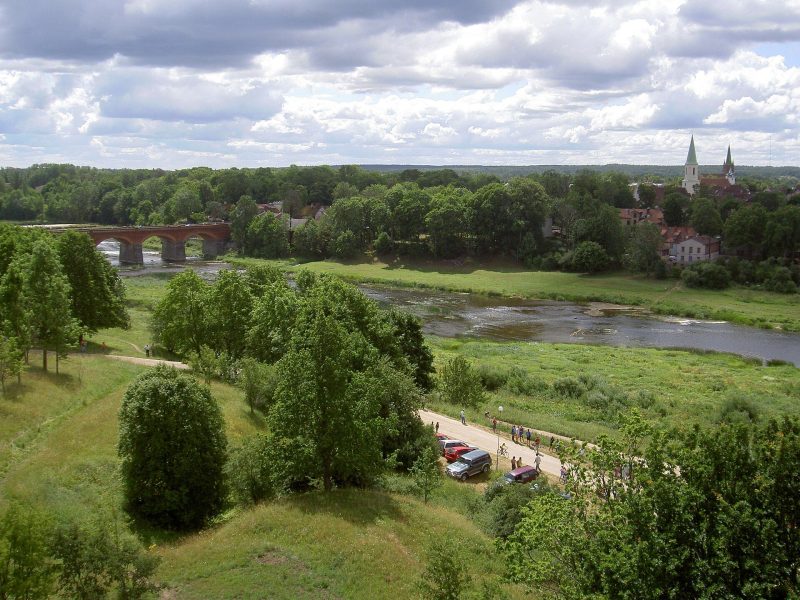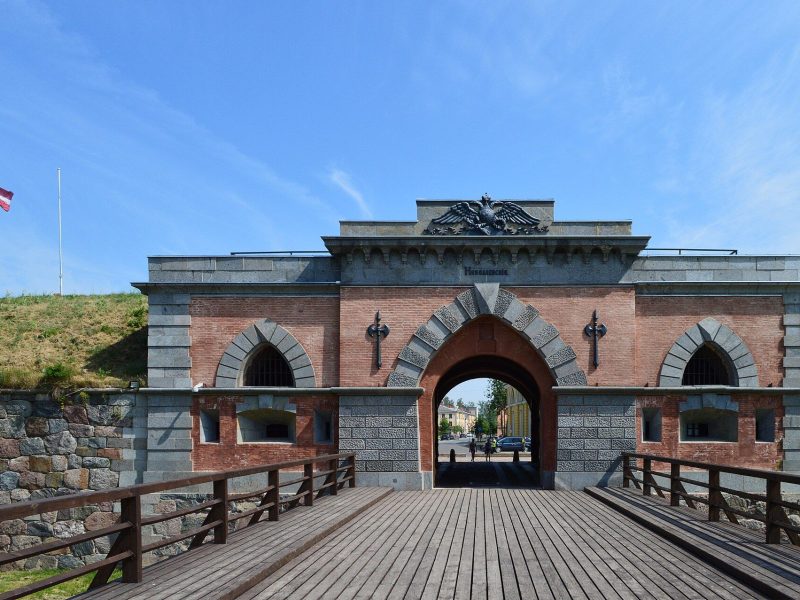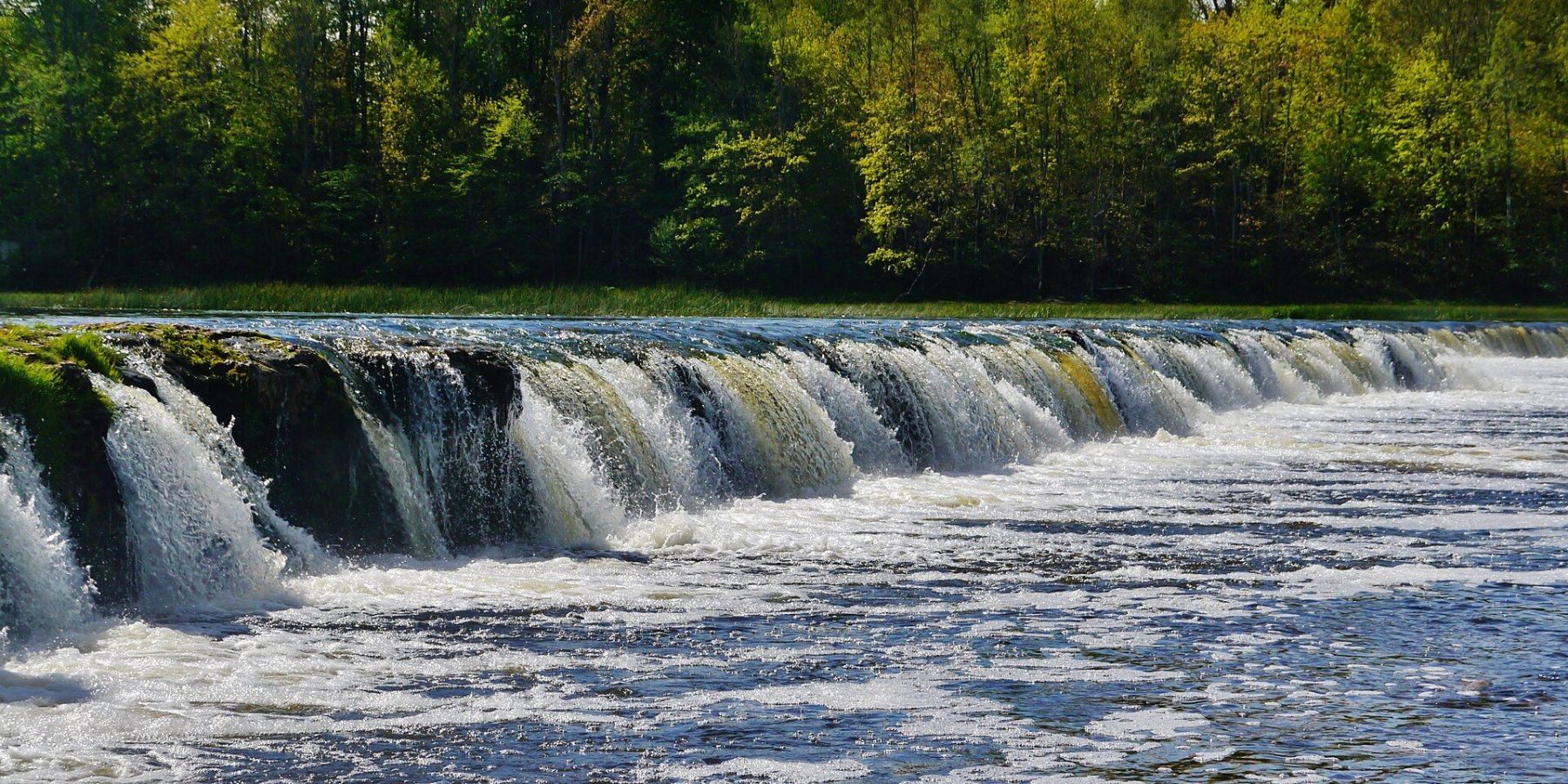
The Venta Rapid in Kuldīga is known as the widest waterfall in Europe. It isn’t tall — in places barely two metres — but water falling across the whole width of the Venta, together with the old brick bridge and Kuldīga’s historic town, makes one of Latvia’s best-known views. In spring you may even see fish leaping up the falls.
At a glance
| Location | on the Venta river in central Kuldīga, by the old brick bridge |
| Width | about 249 m; up to ~270 m in floods |
| Height | 1.6–2.2 m depending on water level |
| Status | natural monument in the Venta Valley nature reserve |
| Brick bridge | built 1874, 164 m long, about 240 m from the falls |
| Visiting | open access, free |
How the falls formed
The rapid is a ledge of Devonian dolomite across the riverbed. The softer lower layers wash out faster, leaving the hard top layer overhanging until it breaks off, so the falls creep slowly upstream. The height varies from 1.6 to 2.2 metres and the width averages about 249 metres — more in spring floods.
The falls also shaped Kuldīga’s history: in the Middle Ages they blocked shipping on the Venta, and the town grew up right here. In the 17th century Duke Jacob of Courland had a bypass canal dug on the right bank, but the dolomite proved too hard and the work was abandoned. Legend has it that he ordered the falls blown up, only for his palace walls to crack. In the 19th century the Russian Empire started the Venta–Dubysa canal, halted in 1831; parts of it can still be seen.
The “flying fish”
Kuldīga was once called the town where fish are caught in the air. In spring, vimba and other fish swim up the Venta to spawn and try to leap the falls. In Duke Jacob’s time fish traps were cut into the rock and large wicker baskets set to catch fish that failed to make the jump; in the 1720s some 70 farmsteads each had to place one basket. Today fishing at the falls is banned, but you can watch the fish jump from the bank, and Kuldīga celebrates with its spring festival “Lido zivis” (Flying fish).
When to go
April and May are vimba season — the most spectacular time. On hot summer days people wade along the shallow edge of the falls (careful: the dolomite is slippery, and depth varies from 50 cm to 2 m). Autumn colours the valley, while in hard frost the falls can vanish under built-up slush ice and water, as happened in January 2024.
Did you know?
The last sturgeon at the Venta Rapid was caught in 1892. Today the main fish trying to leap the falls is the vimba.
Visiting
- Where: central Kuldīga; the best views are from the old brick bridge and both banks.
- Admission: open access, free.
- Parking: in the town centre; the old-town streets are narrow, so it’s easier to park and walk.
- Time needed: 30 minutes for the falls and bridge; at least half a day with the old town.
- Accessibility: the views from the bridge and riverbank are step-free; wading the falls is not wheelchair-friendly.
- Combine with: Kuldīga’s old town, a UNESCO World Heritage site since 2023, the Alekšupīte waterfall and the Riežupe sand caves. On a longer Courland trip, head on to Cape Kolka.
FAQ
How wide is the Venta Rapid?
About 249 metres, and wider in floods — which is why it is called the widest waterfall in Europe. It is only 1.6–2.2 m high.
When can I see the flying fish in Kuldīga?
In spring, usually April and May, when vimba head upstream to spawn. Timing depends on water temperature and level.
Can I walk on the falls?
In summer many people wade along the shallow edge, but the dolomite is slippery and the depth changes. Do so at your own risk and keep out of the current.
Sources: lv.wikipedia.org “Ventas rumba”; en.wikipedia.org “Venta Rapid”; LSM (2023 — vimba leaping; 2024 — the falls under ice). Event dates change — check visit.kuldiga.lv.