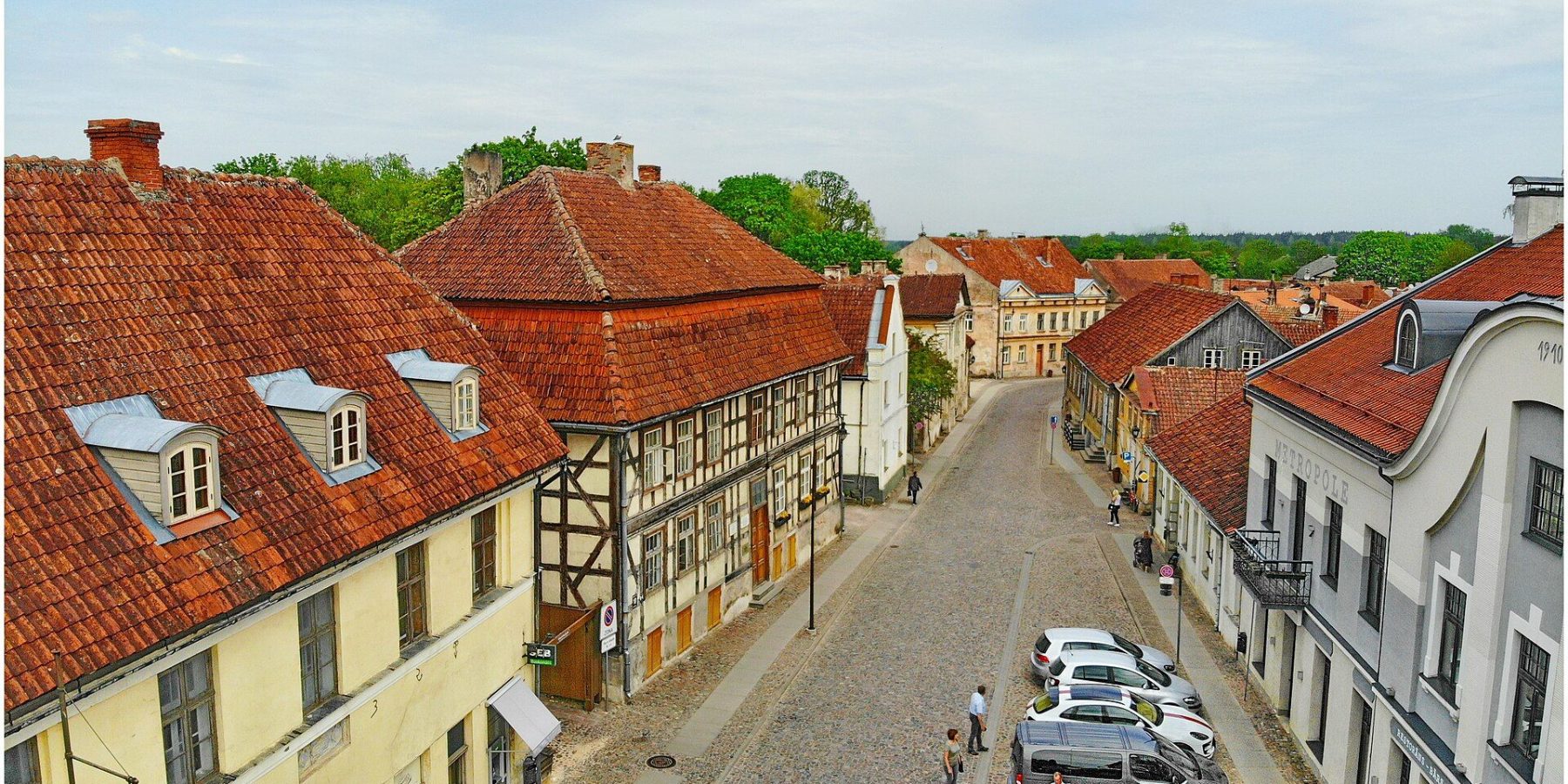
Kuldīga is the only Latvian town outside Riga whose old town is on the UNESCO World Heritage List — since September 2023. It is small, compact and easy to explore on foot: red-tiled roofs, wooden houses along the Alekšupīte stream, a brick bridge over the Venta and Europe’s widest waterfall a few minutes from Town Hall Square.
At a glance
| From Riga | ~155 km |
| UNESCO | “Old town of Kuldīga”, inscribed 17 September 2023 |
| First mentioned | 1242 |
| Time needed | 1 day; 2 days with the Riežupe caves and surroundings |
| Tourist info | Old Town Hall, Baznīcas iela 5 |
Why Kuldīga is on the UNESCO list
At its 45th session in 2023 the World Heritage Committee inscribed the Old town of Kuldīga under criterion (v), as an outstanding example of traditional townscape showing the town’s development from the Middle Ages to the early 20th century. Kuldīga began in 1242 with a Livonian Order castle on the Venta, joined the Hanseatic League in 1368 and in 1596–1616 was, with Jelgava, one of the capitals of the Duchy of Courland. The protected area also covers the confluence of the Venta and the Alekšupīte and the Venta Rapid.
What to see
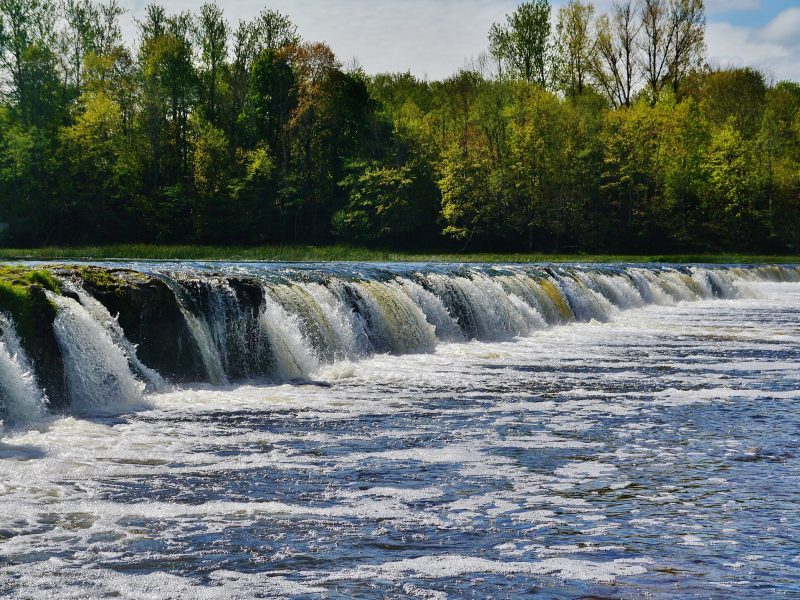
- Venta Rapid — Europe’s widest waterfall, usually 100–110 m wide and up to 270 m in floods, 1.6–2.2 m high. In spring you can watch vimba fish leaping it. Read more.
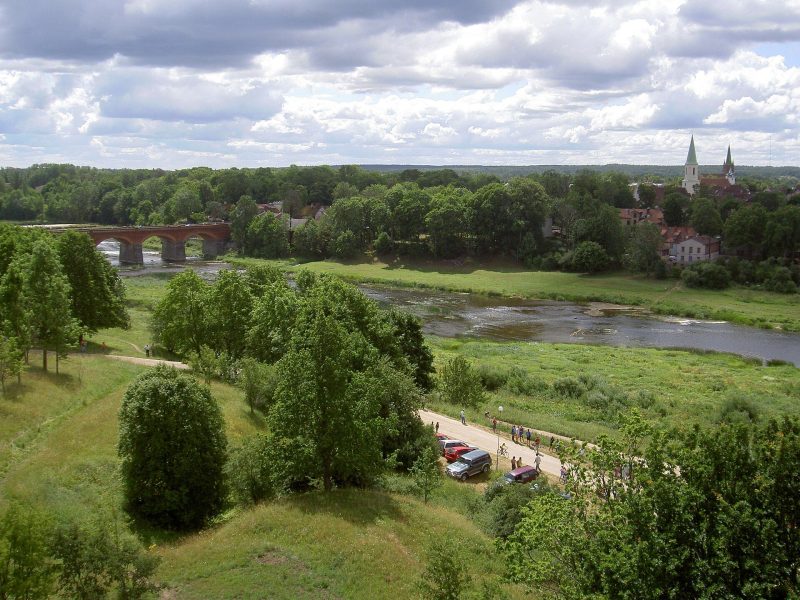
- Brick bridge — built in 1874 to a design by Otto Dietze, 164 m long, the longest brick bridge in Latvia. Two spans were blown up in World War I and later rebuilt. Best view of the rapid.
- Town Hall Square — the centre since the 17th century, after a flood and the great fire of 1615 moved the town’s heart here. The Old Town Hall (Baznīcas iela 5) houses the tourist office; the New Town Hall dates from 1860, in Italian Renaissance style. Scenes from “Emil’s Mischiefs” and “Krasts” were filmed here.
- Alekšupīte and its waterfall — the stream runs right past house walls, earning Kuldīga the nickname “Venice of Latvia”. Where it meets the Venta it drops 4.15 m, one of the highest waterfalls in Latvia.
- Baznīcas iela — No. 7 is the town’s oldest house, built in 1670 and remodelled in the 18th century. With pedestrian Liepājas iela, it is the best street for wooden architecture.
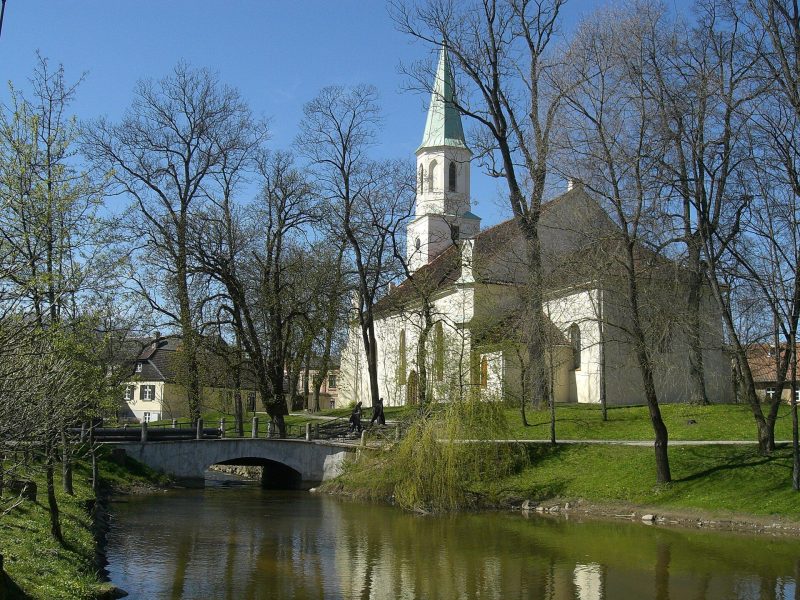
- St Catherine’s Church — Lutheran, founded in 1252 and named after the town’s patron saint; Duke Jacob was baptised and married here.
- Holy Trinity Catholic Church — built in 1640, a listed architectural monument.
- Castle ruins and sculpture park — on Rumba hill, where the Order castle stood, a fragment of a cross-vaulted window survives among 22 works by sculptor Līvija Rezevska.
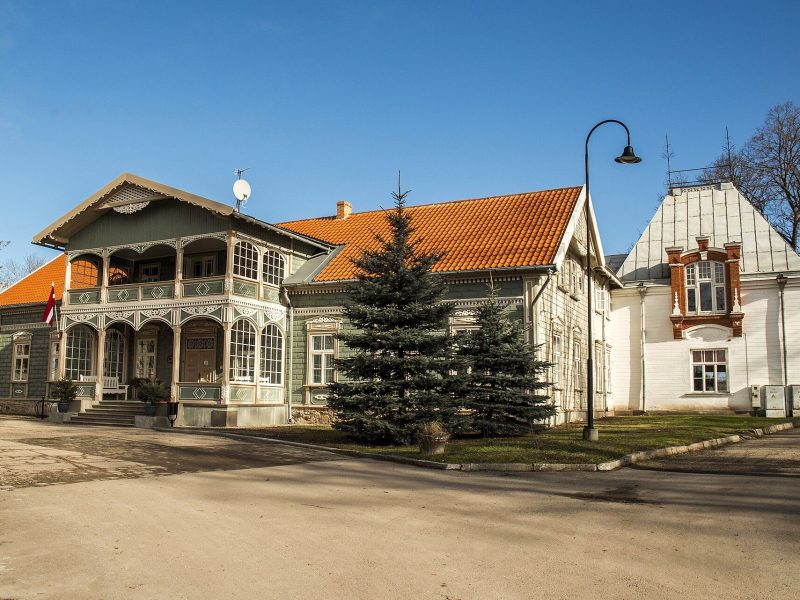
- Kuldīga District Museum — in the Bangerts villa (Pils iela 5), open since 1935 with over 85,000 items. Local legend says the villa was the Russian pavilion at the 1900 Paris World Exhibition.
Did you know?
Kuldīga was nominated as “Kuldīga / Goldingen in Courland”, but at ICOMOS’s request the name was simplified to “Old town of Kuldīga” on inscription. An earlier tentative listing from 2011 was called “Kuldīga Old Town in the Primeval Valley of the River Venta”.
Visiting
- Getting there: ~155 km from Riga by car; direct buses run from Riga International Bus Station — check 1188.lv or autoosta.lv.
- Parking: old-town streets are narrow; park outside the centre and walk.
- Time needed: 3–5 hours for the old town, rapid and bridge; a full day with the museum and the Riežupe sand caves (about 460 m open to visitors).
- Best time: April to June for leaping fish, or warm summer evenings when people wade across the rapid.
- Info: Kuldīga Tourist Information Centre, Baznīcas iela 5, +371 29334403, tourinfo@kuldiga.lv.
FAQ
When did Kuldīga become a UNESCO site?
On 17 September 2023, at the 45th session of the World Heritage Committee, as the “Old town of Kuldīga”.
How far is Kuldīga from Riga?
About 155 km — roughly a two-hour drive; direct buses also run.
What can I see in one day?
The Venta Rapid, the brick bridge, Town Hall Square, the Alekšupīte and its waterfall, Baznīcas iela with the oldest house, and the castle park.
Sources: UNESCO World Heritage Committee decision 45 COM 8B.18 (whc.unesco.org); lv.wikipedia.org and en.wikipedia.org “Kuldīga”; redzet.lv; hanse.org; Kuldīga District Museum (kuldigasmuzejs.lv).