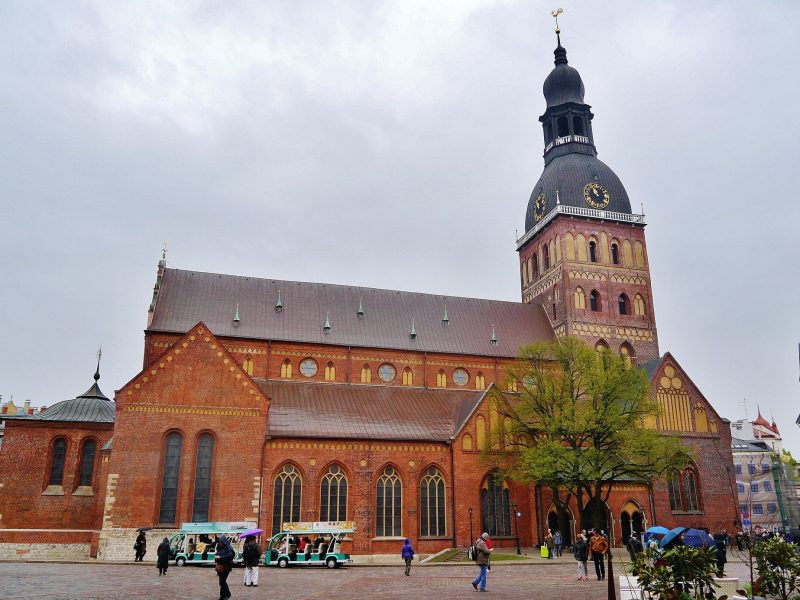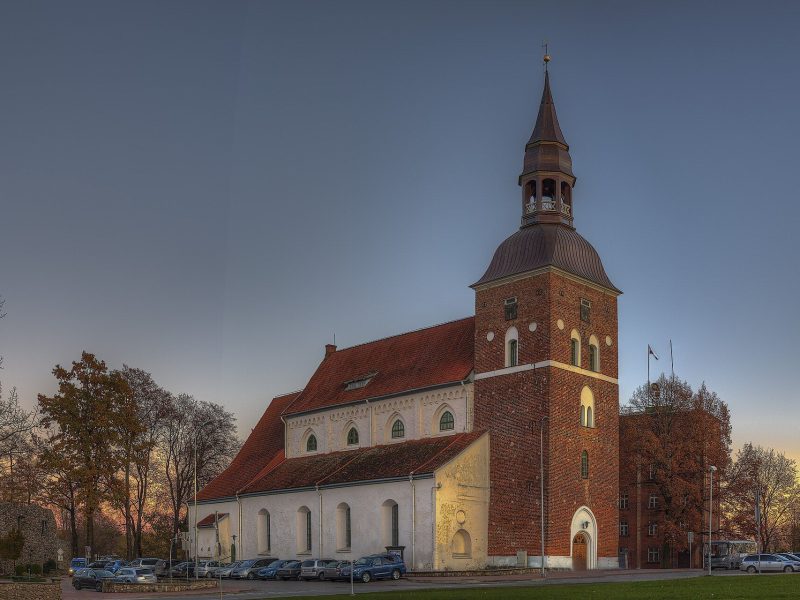
In Old Riga, directly opposite the Saeima (parliament), rises a slender pyramid-shaped spire topped not by a cross but by a rooster. That is the first clue to the unusual story of St James’s Cathedral: a medieval church that changed confession several times over the centuries and has been the cathedral of the Roman Catholic Archdiocese of Riga since 1923.
At a glance
| Confession | Roman Catholic; cathedral of the Archdiocese of Riga (since 1923) |
| First mentioned | 1226 |
| Style | Early Gothic, red brick |
| Tower | Pyramid spire with a rooster; height given as roughly 80–92 m depending on source |
| Organ | Emil Martin organ (1913), 37 stops, behind H. A. Contius’s 18th-century case |
| Status | State-protected monument, part of the Historic Centre of Riga (UNESCO) |
A church that changed hands
The church is first mentioned in 1226. It stood outside the city walls of the time and served the suburb; the craft guilds kept their own altars here. The Reformation in Riga began in this building: Lutheran preaching started here in 1522, and from 1523 it was the city’s first Latvian Lutheran congregation.
In 1582 King Stephen Báthory handed it to the Catholics and the Jesuits, and during the Calendar Riots of 1584 a Lutheran crowd wrecked the Catholic furnishings. After the Swedes took Riga in 1621 the church returned to the Lutherans and stayed Lutheran until 1923, when, after the concordat between Latvia and the Holy See, the government gave it to the Catholics. A referendum against the transfer on 1–2 September 1923 won a majority but failed for lack of quorum. Archbishop Antonijs Springovičs celebrated the first Mass in the new cathedral on 3 May 1924.
Architecture and interior
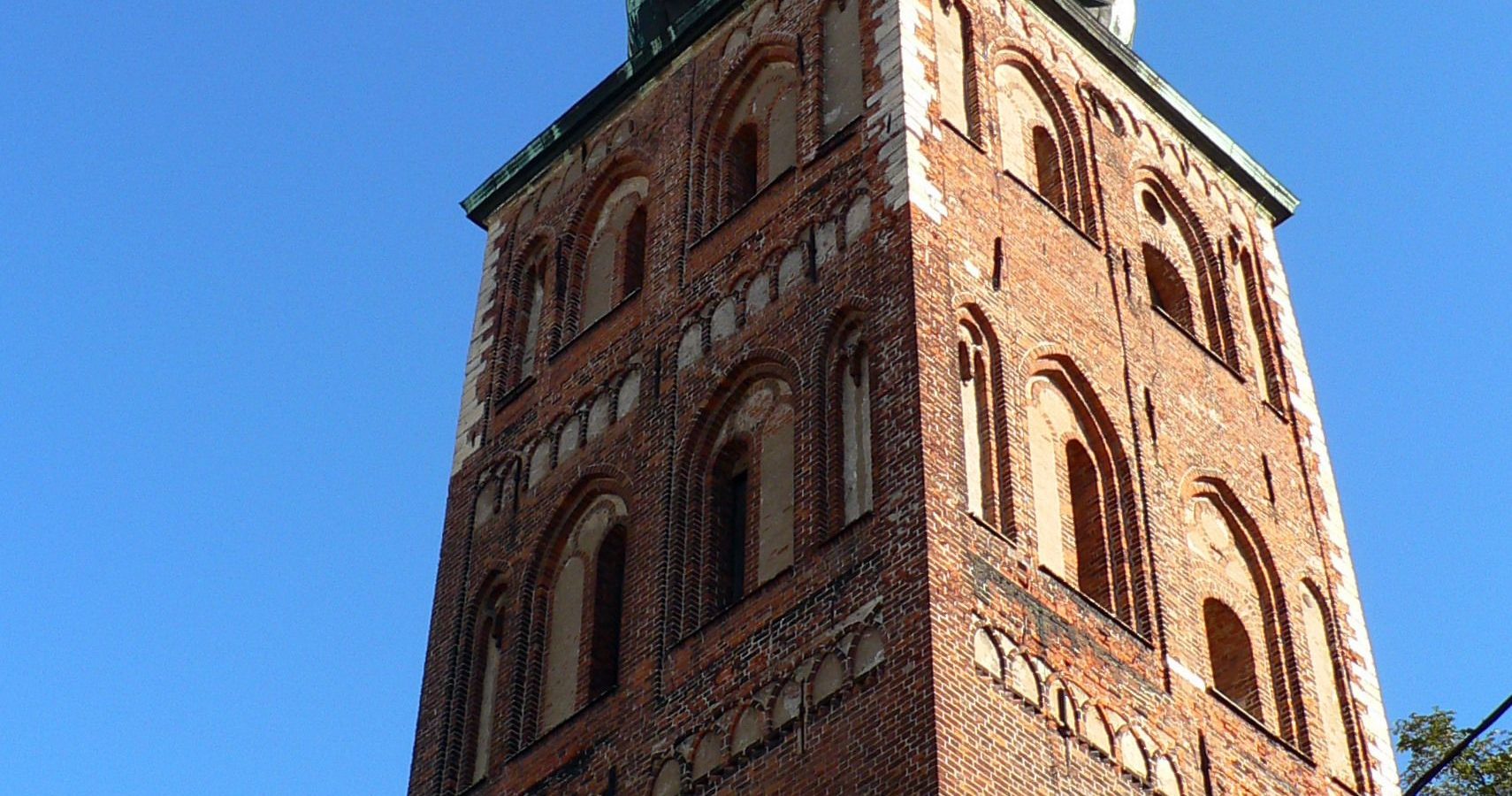
The building shows the transition from Romanesque to Gothic: a square choir without an apse, a short three-aisled nave and a tower over the west end. It is the best-preserved example of the pyramid-shaped towers typical of Riga’s medieval churches, and its clock dates from 1480. Two cannonballs set into the vaults recall the Russian siege of 1656.
Heinrich Andreas Contius built an organ here in 1763; only its case survives. Behind it, in 1913, Emil Martin built a 37-stop Romantic organ, his largest instrument in Latvia. Two popes have visited: John Paul II in 1993 and Francis in 2018. The cathedral marked its 800th anniversary in 2025.
Did you know?
In the 15th century a bell was hung outside the tower under a small canopy. It served as the city’s alarm bell and, by tradition, called people to executions in Town Hall Square.
Visiting
- Where: Jēkaba iela 9, Old Riga, opposite the Saeima building.
- When: no official visitor hours are published; the church is open for Mass and usually during the day. Groups should contact the parish first: +371 29991637.
- Price: no set admission fee; donations support the restoration.
- Etiquette: this is a working Catholic cathedral — cover shoulders, men remove hats, no photos during Mass.
- Combine with: Riga Cathedral and St Peter’s Church tower, both a few minutes’ walk away.
FAQ
Why does a Catholic cathedral have a rooster on its spire?
The rooster is the traditional emblem on Riga’s Lutheran church towers. The church was Lutheran until 1923 and the rooster was kept as a reminder of that history.
Since when has it been a Catholic cathedral?
Since 1923, when the government transferred it to the Catholic Church; the first cathedral Mass was held on 3 May 1924.
What did archaeologists find here?
Excavations by the south wall in 2018 uncovered nearly 300 medieval and early modern burials and the largest known ossuaries in the Baltic states.
Sources: lv.wikipedia.org “Rīgas Svētā Jēkaba katedrāle”; en.wikipedia.org “St. James’s Cathedral, Riga”; liveriga.com; LSM (2024, 2025); lvportals.lv (2019).