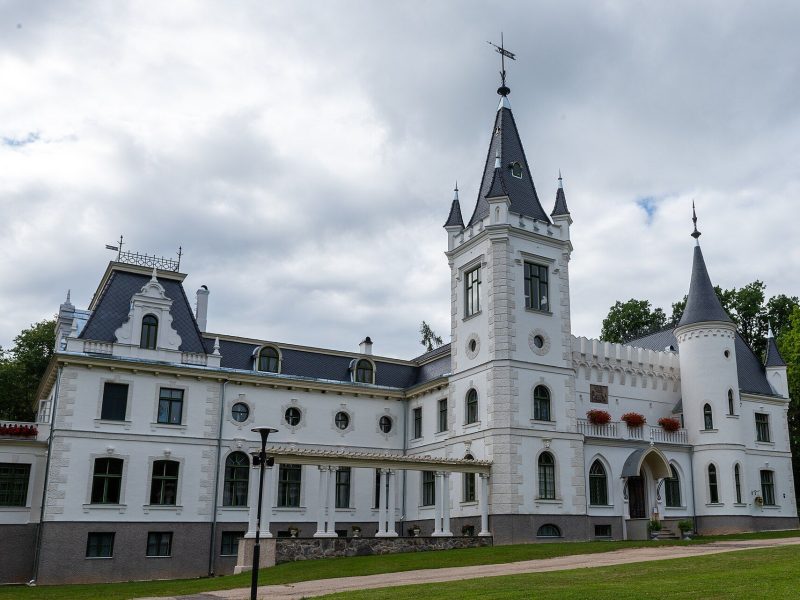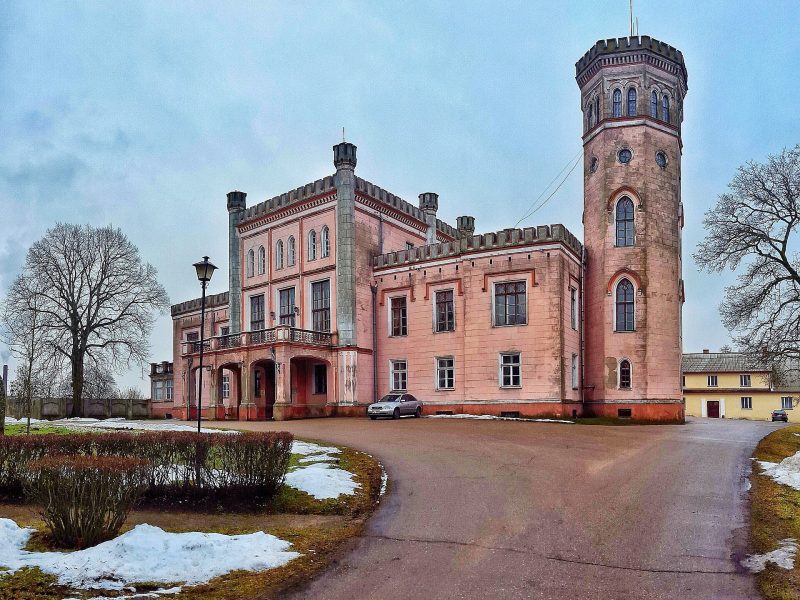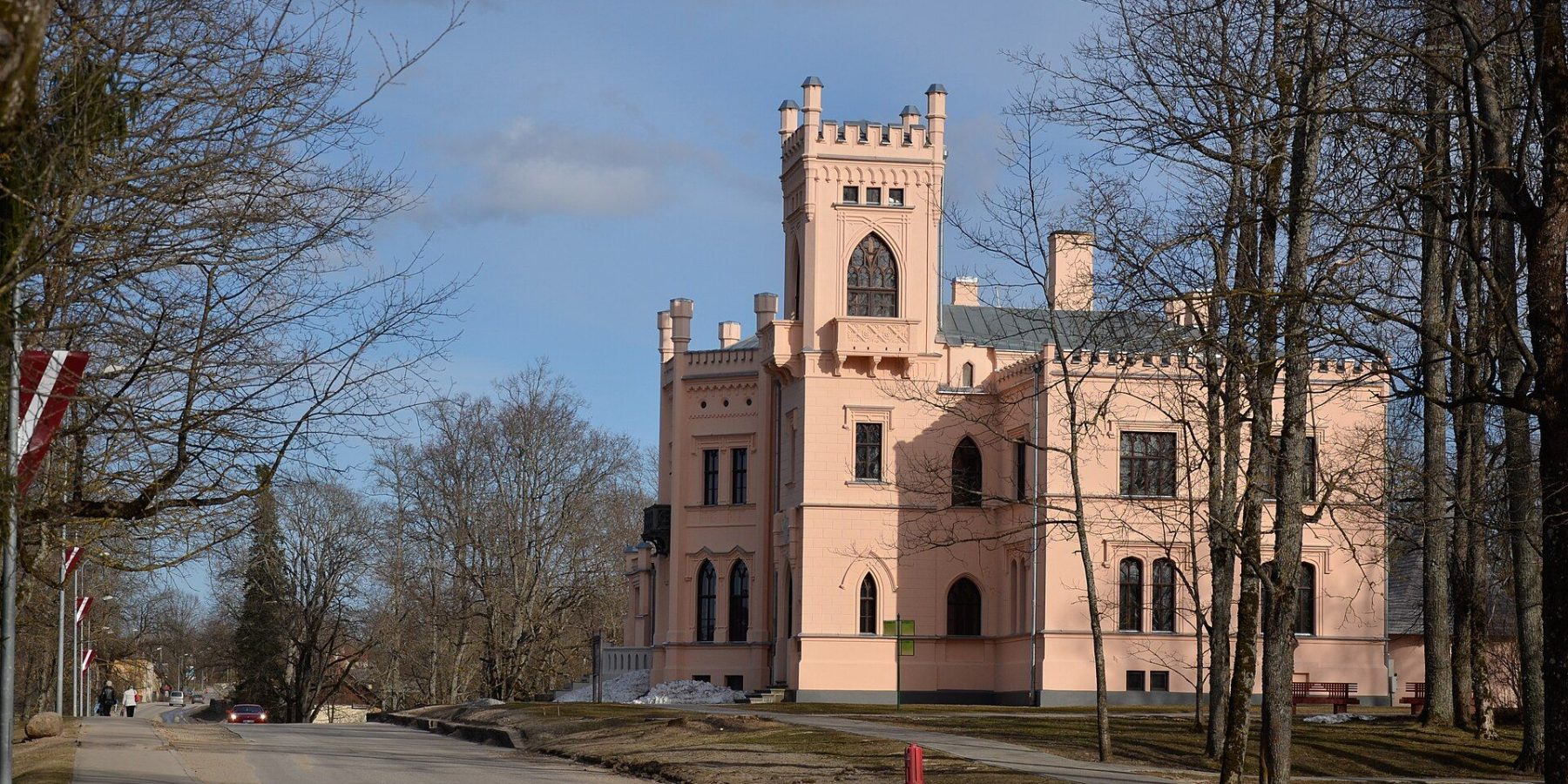
On the shore of Lake Alūksne, at the edge of the manor park, rises a Tudor Gothic Revival palace with a slender, off-centre tower — the Alūksne New Palace. Baron Alexander von Vietinghoff built it in the mid-19th century, and it was the last building his family added to the Alūksne estate. Since 1959 it has housed the Alūksne Museum, and the ground-floor rooms keep their rich decorative paintwork.
At a glance
| Location | Pils iela 74, Alūksne — in the manor park on the lakeshore |
| Built | 1859–1863 |
| Commissioned by | Baron Alexander von Vietinghoff |
| Style | Tudor Gothic Revival |
| Architect | Not known for certain; an 1862 church register names local builder Robert Miller |
| Today | Alūksne Museum (since 1959) |
History
The Vietinghoffs’ last building
The Vietinghoff family’s ties to Alūksne go back to the 14th century, when Arnold von Vietinghoff commanded the local Order castle. After the family sold its Zolitūde estate near Riga in 1795, Alūksne became one of its main summer residences. Baron Alexander von Vietinghoff built the New Palace in 1859–1863; “New” sets it apart from the older 18th-century manor house nearby.
The designer is not known for certain. Architect Pauls Kampe suggested the Prussian architect Paul Benjamin Polnaus, Jānis Zilgalvis proposed Johann Daniel Felsko, former chief architect of Riga, while the 1862 Alūksne church register names the local builder Robert Miller.
From baron’s residence to museum
The palace was also a place for public life — in 1879 the rural teachers of Valka district met here, and in 1884 local landowners, merchants and intelligentsia founded a volunteer fire brigade society in it. In 1905 a punitive expedition was quartered here. After the First World War the Vietinghoffs left Alūksne, taking part of the interior with them.
In the 1920s and 1930s the palace was the headquarters of the 7th Sigulda Infantry Regiment, which refitted the interior and installed sewerage. After the Second World War it was taken over by the Soviet security services; central heating went in during the late 1950s, and in 1959 the museum opened.
What to see
- The façade — the slender asymmetrical tower and the crenellated central projection; the main front faces north towards the lake and park.
- Vietinghoff coat of arms — above the entrance below the tower, featuring a fox as a symbol of wisdom and cunning.
- Painted interiors — ground-floor rooms keep decorative painting in Neoclassical, Neo-Renaissance, Neo-Rococo and Moorish styles.
- Alūksne Manor Park — one of the town’s main sights, right next to the palace.
Did you know?
In 2014 architect Ilze Māra Janelis found an inventory of the property of the late Baron Konstantin Vietinghoff in the Latvian State Historical Archives — a key clue to how the palace was furnished before the First World War.
Visiting
- Where: Pils iela 74, Alūksne.
- When: 1 June–30 September, Tuesday–Sunday 10:00–18:00; 1 October–31 May, Tuesday–Saturday 10:00–17:00. Closed Mondays (and Sundays in winter).
- Tickets: prices are not published on the official website — ask the museum, tel. +371 64381321 or +371 25665538.
- Combine with: Stāmeriena Palace is within reach in the same part of Vidzeme.
FAQ
Why is it called the New Palace?
To distinguish it from the older 18th-century manor house nearby in the same estate complex.
Who designed the Alūksne New Palace?
No one knows for certain. Researchers suggest Paul Benjamin Polnaus or Johann Daniel Felsko, while the church register names local builder Robert Miller.
What is in the palace today?
The Alūksne Museum, with exhibitions and the surviving 19th-century painted interiors.
Sources: aluksnespils.lv (palace complex, opening hours); en.wikipedia.org “Alūksne New Castle”. Hours and prices can change — check before you go.