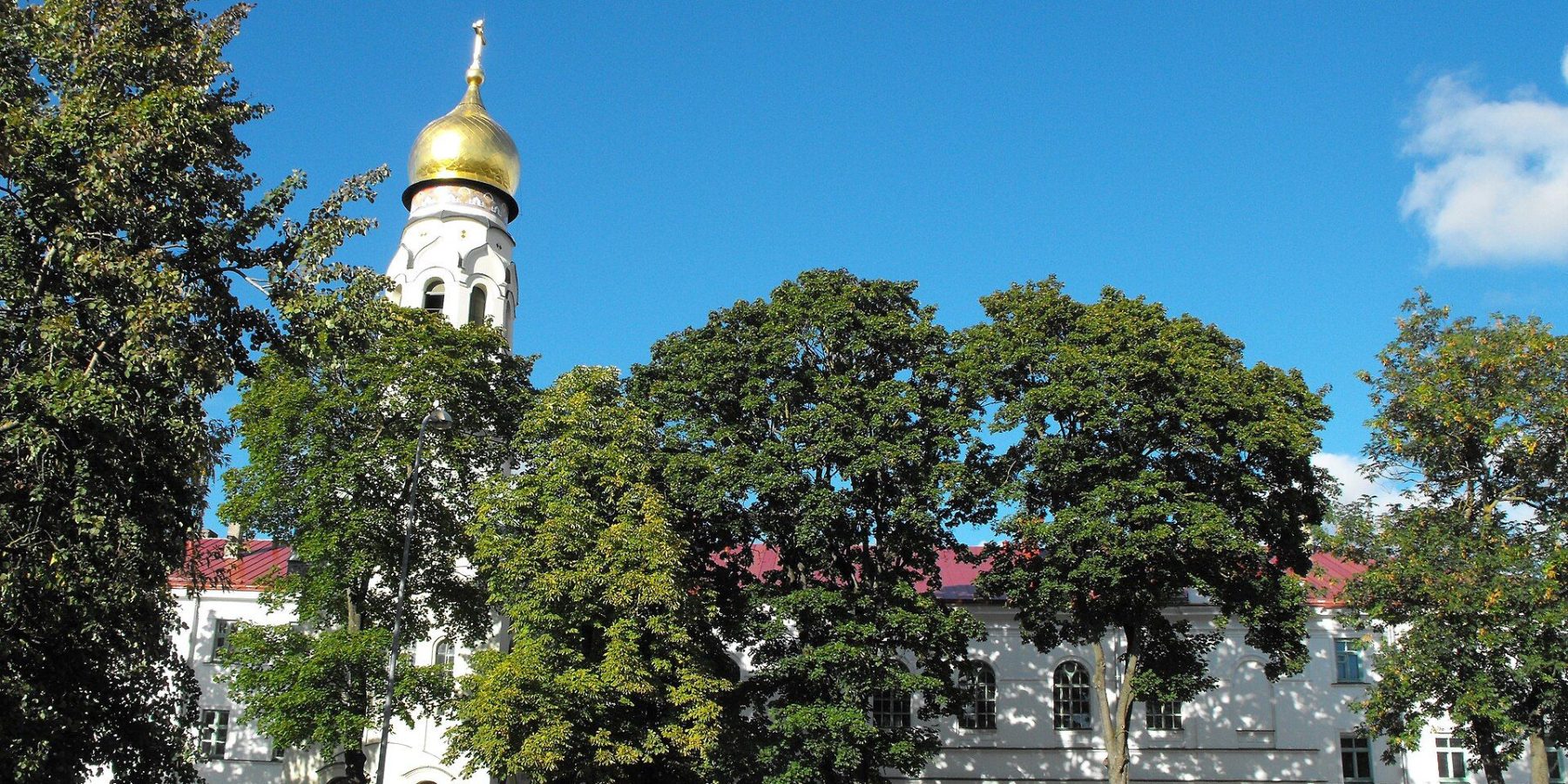
In Riga’s Moscow Suburb, on Mazā Krasta iela, a bell tower with a gilded, helmet-shaped dome rises above the low roofs. It belongs to the prayer house of the Riga Grebenshchikov Old Believers’ community — the largest Old Believer house of worship in the world and one of the oldest Old Believer communities, active without a break since the mid-18th century. Services here still follow the pre-reform traditions of the Russian church, and the interior holds more than a thousand icons.
At a glance
| Confession | Old Believers — Pomorian (priestless) tradition; Pomorian Old-Orthodox Church |
| Community | Founded no later than 1760; around 20,000–25,000 members |
| Buildings | Complex took shape in the mid-19th century; rebuilt in 1886 |
| Bell tower | After 1905; city architect Reinhold Schmaeling; gilded helmet-shaped dome |
| Interior | Six-tier iconostasis, 1,009 icons and 626 old manuscripts and books (1979 inventory) |
| Status | Architectural monument of national importance (prayer house and almshouse complex) |
A community that outlived fires and bans
Old Believers are Orthodox Christians who rejected Patriarch Nikon’s church reforms in the 17th century; persecution drove many of them to the Baltic. The Riga community opened its first prayer house in 1760 together with an almshouse. In 1793 it bought a wooden building that it later enlarged, but in 1812, as Napoleon’s army approached Riga, the suburbs were burned and the prayer house went up in flames with them.
After the fire the community began building a brick hospital and church. It took its name from Alexei Grebenshchikov, a merchant from Jelgava (Mitau) who supported it. Through the 19th century the government repeatedly restricted Old Believers — closing their school and banning their parish registers — yet the prayer house survived. In 1886 it was rebuilt with a fourth storey over the prayer hall, and a women’s wing was added to the almshouse.
Bell tower and interior
Old Believers were allowed to build a bell tower only after the 1905 manifesto on religious tolerance. It was designed by Riga city architect Reinhold Georg Schmaeling in an Old Russian style with a helmet-shaped dome. The dome was gilded in 1937; in 1999 the tower was repaired and the dome gilded again.
The prayer hall can hold several thousand people. The main iconostasis has six tiers of icons, almost entirely covered in silver revetments. During the Soviet era its listing as a monument protected the complex and its collection: a 1979 inventory counted 1,665 religious objects, including 1,009 icons and 626 manuscripts and books. The Pomorian tradition has no priests — services are led by a lay spiritual leader and are known for ancient unison chant.
Did you know?
For more than 50 years of Soviet rule, the Grebenshchikov community published the only regular Old Believer church calendar in the whole USSR.
Visiting
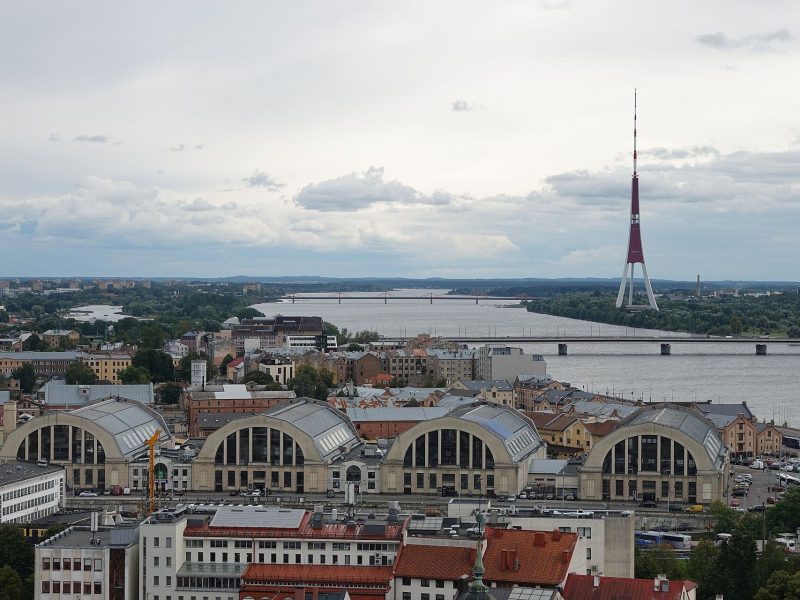
- Where: Mazā Krasta iela 73, Riga, in the Latgale Suburb, about a 20-minute walk from the Central Market.
- When: no official visiting hours are published; the church is usually open around morning and evening prayers. The community museum in the basement can be seen by prior arrangement only.
- Etiquette: the dress code is strict — no shorts; women are expected to wear a skirt and head covering, men remove hats. Photography inside is not allowed.
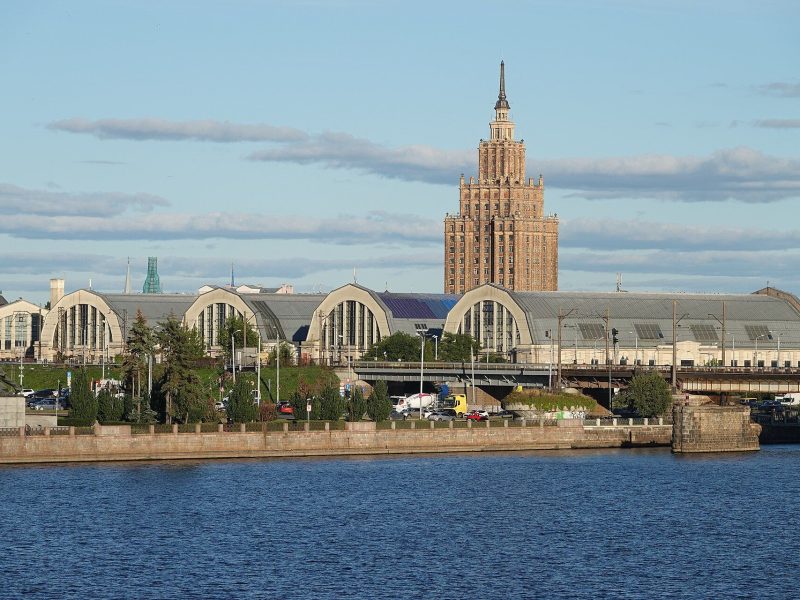
- Combine with: the nearby Academy of Sciences viewing platform, which looks out over the gilded dome, and St Peter’s Church tower in the Old Town.
FAQ
Can tourists go inside?
Yes, as long as you respect the community’s rules: suitable clothing, quiet and no photos. Opening outside service times is not guaranteed, so allow some flexibility.
Why is it called the largest in the world?
It is the largest Old Believer prayer house building and one of the largest congregations — around 20,000–25,000 members — and is regarded as the oldest Old Believer community in continuous existence.
What are priestless Old Believers?
A branch of the Old Believers without an ordained clergy; services are led by a spiritual leader chosen from the congregation.
Sources: LSM “Pastkarte no pagātnes: Rīgas Grebenščikova vecticībnieku lūgšanu nams – lielākais pasaulē” (2021); ru.wikipedia.org “Рижская Гребенщиковская старообрядческая община”; en.wikipedia.org “Grebenstchikov House of Prayer, Riga”; lvportals.lv (2010); National Heritage Board of Latvia (likumi.lv, 2023).