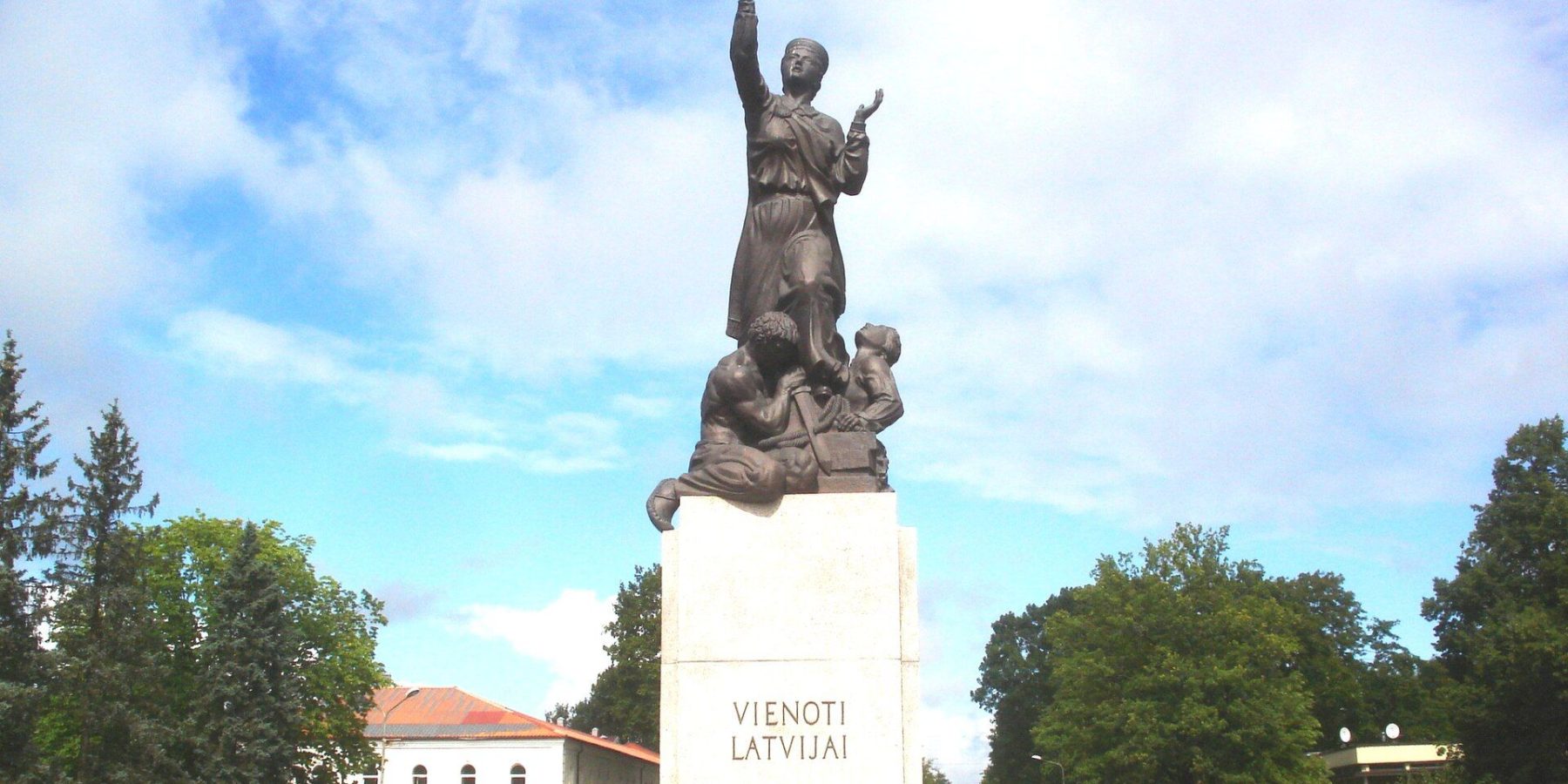
In the heart of Rēzekne, on Atbrīvošanas aleja, stands one of Latvia’s strongest symbols of independence — the “United for Latvia” monument, known to everyone as the Māra of Latgale. Toppled twice and raised three times, it tells the story of Latgale belonging to Latvia, and of what an occupying power tried to erase.
At a glance
| Official name | “Vienoti Latvijai” (United for Latvia); originally the Monument to the Liberation of Latgale |
| Location | Atbrīvošanas aleja 93, Rēzekne — the square by the city council |
| Unveiled | 8 September 1939 |
| Sculptor | Kārlis Jansons; restored by Andrejs Jansons and Indulis Folkmanis |
| Toppled | 1940 and 1950 |
| Re-erected | 1943 and 13 August 1992 |
| Visiting | Open access day and night, free |
What the monument shows
Three bronze figures stand on a granite pedestal. The standing woman raises a gilded cross — free Latgale and its Christian culture. At her feet a kneeling man breaks his chains, the fight for independence: Latgale was the last region liberated, in early 1920. A kneeling young woman prays, standing for the role of Catholicism in Latgale. The pedestal bears the words “Vienoti Latvijai” and the arms of Latgale’s four district towns.
Did you know?
A woman from Cēsis, Villija Everte, posed for the body of the main figure but refused to let her face be used — so Māra’s face was taken from the woman on Latvia’s silver five-lats coin.
History
Latgale public figures proposed the monument in the 1920s to mark the region’s liberation from the Bolsheviks. The foundation stone was laid on 8 June 1930, the 10th anniversary of the liberation. Student Leons Tomašickis won the design competition with his model “Māras zeme”; sculptor Kārlis Jansons developed and made the monument, and the bronzes were cast in Finland. It was unveiled on 8 September 1939, days after World War II began.
After the Soviet occupation the cross was removed, the inscription erased and, on the night of 5–6 November 1940, the monument was pulled down. It was re-erected under German occupation on 22 August 1943 with donations from Latgalians, then destroyed again by the Soviet authorities in June 1950. The fate of the original bronzes is still unknown. A Lenin statue stood on the spot from 1965 until 27 August 1991.
Rebuilding was approved in 1989. Andrejs Jansons, the original sculptor’s son, and Indulis Folkmanis recreated the monument from family sketches and photographs. It was unveiled on 13 August 1992 during the first World Latgalian Gathering and contains a small fragment of the original, kept for about 42 years by Rēzekne resident Ludmila Sahareva.
Visiting
- Where: Atbrīvošanas aleja 93, in the middle of the boulevard by the city council.
- Price: free, open day and night.
- Time needed: 15–20 minutes; combine it with a walk through central Rēzekne.
- Info: Rēzekne Tourist Information Centre, +371 26332249.
Sources: LSM (2019) series on the Māra of Latgale; lv.wikipedia.org “Latgales Māra”; Latvijas Vēstnesis (1997, 2005, 2008); militaryheritagetourism.info.